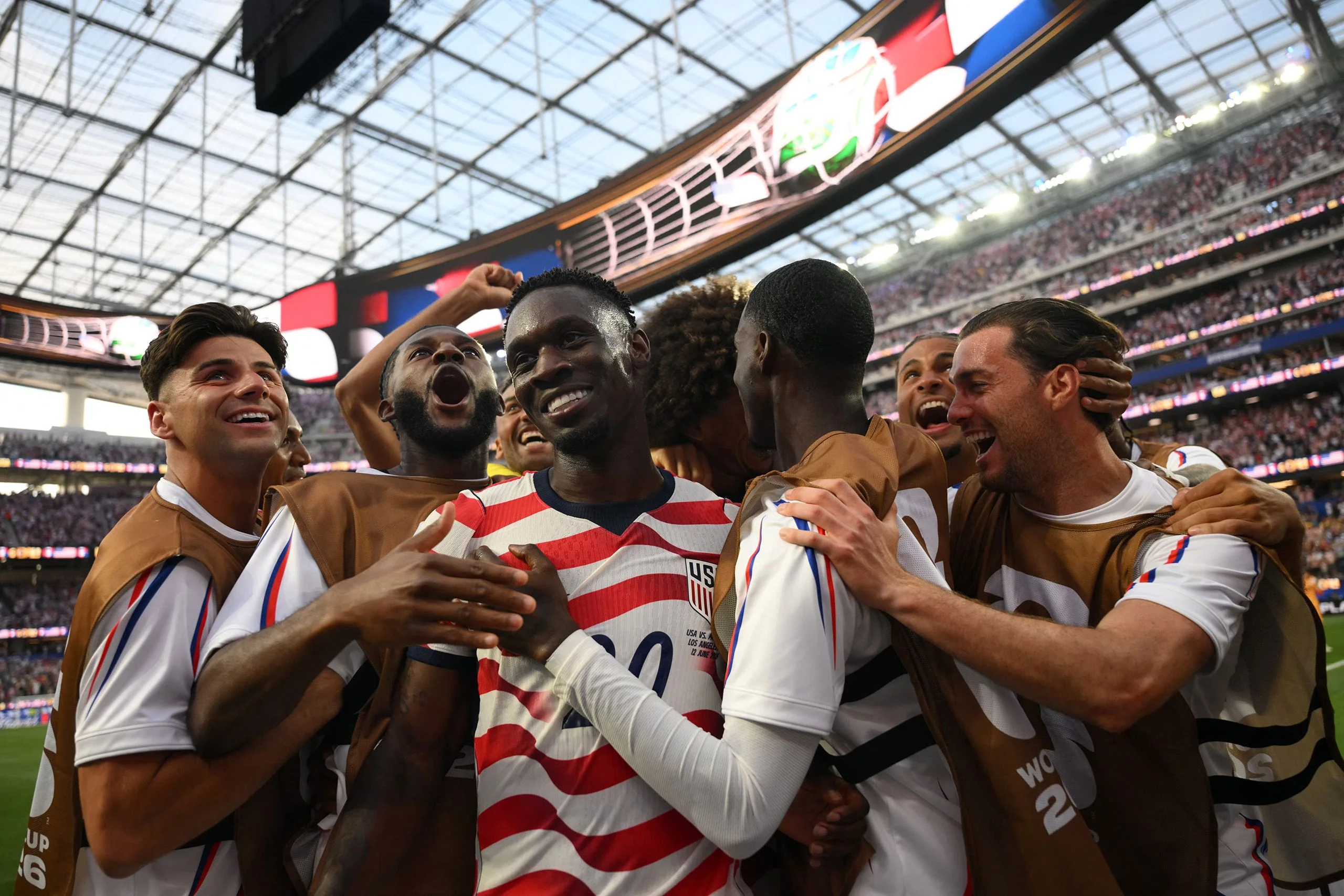
The Fourteenth Amendment was intended to right a wrong, not to beat Paraguay and Australia on the pitch—but then, American history is a long succession of accidents that lead to choices that, in retrospect, come to manifest as destiny. Here is one: when Florence Balogun, a Nigerian who lived in London, visited New York twenty-five years ago while heavily pregnant, airline staff refused to let her on the plane home, and so Folarin Balogun was born in Brooklyn. He was not even two months old when he went home to the United Kingdom—with American citizenship as his birthright.
When Balogun spoke to the press after scoring twice in the U.S.’s brilliant victory over Paraguay in their first match of the 2026 World Cup, and again after making a strong run that forced the first goal in the U.S.’s second World Cup match, a 2–0 win over Australia, he did so with an English accent. He joined Arsenal’s academy when he was eight, and before long he began to make his way through the English national-team system. In 2021, he was called up to the England U-21 team, a natural step toward a spot on the storied Three Lions. But England had a glut of talent at the striker position. Balogun was also eligible to play for Nigeria, but they had Victor Osimhen, one of the best in the world. The U.S. team represented possibility, for both sides.
For years, the U.S. team had been built around hustle and heart, not technical skill and scoring prowess. Balogun was something new, something that the U.S. obviously needed. During the 2022 World Cup, in Qatar, the U.S. looked full of promise and earned its young players the reputation of a golden generation. But they’d scored only three goals in the entire tournament. The U.S. had never had a natural striker like Balogun, one with the speed to outrace defenders, the strength to hold his position, and the grace to glide behind the backline. Between his time at Stade de Reims, in Ligue 1, and Monaco, he’d already scored more goals in a major European league than any striker who’d played for the U.S. national team. If he came to the U.S., he could skip straight to the senior team. And the Americans offered him something else: a welcome. When some avid fans sleuthed out that he was in Orlando and talking with the U.S. team, they launched an all-out public courtship. That contributed to his decision, in 2023, to represent the U.S., he said after the game against Paraguay.
Against Australia, as he had against Paraguay, Balogun posed problems for the defense. With Christian Pulisic unavailable, nursing a calf injury sustained against Paraguay, he was joined up top by Ricardo Pepi, and showed his versatility and comfort across the width of the field. Australia was said to be a physical team, with a towering backline, but what Balogun lacked in heft, he made up for in speed. Eleven minutes into the game, he flashed up the left side with the ball and sent a pass across the box to Pepi, which was so powerful that it wrong-footed an Australian defender, who scored an own goal. (It’s the summer of OGs!) Balogun had several more chances in the box during the match, though he failed to finish them, and he used his strong connection with the young defender Alex Freeman to widen the channel on the flank. His pace was enough to match—and, at times, overwhelm—even the Australian players who were known for their quickness, and he managed to play credibly enough with Pepi to keep Australia’s tough, physical backline busy.
Before the tournament, Balogun was mostly unknown to the American public, except by hard-core soccer fans. Now his jersey is in demand. In Seattle, there was a sense of the team harnessing the crowd’s energy, and of the crowd channelling the energy emanating far beyond. When the ball hit the back of Australia’s net, the roar was so percussive that the stadium press box shook. But the biggest reverberations came late that night, as the seagulls picked at scraps in the empty stadium seats. Paraguay beat Türkiye, which meant that the U.S. would be heading to Santa Clara for the round of thirty-two, assured an easier path because they’d won their group.
It’s sometimes said that a national team is a nation distilled into eleven men. Perhaps. The U.S., after all, is a nation of hyphenates and immigrants who came to the country seeking opportunity. Six of the twenty-six players on the U.S. national team were born in another country, and twelve were eligible to play for other national teams. Freeman scored the U.S.’s second goal against Australia off a deflected strike by Sergiño Dest, whose Surinamese-American father met his Dutch mother in Amsterdam on a visit from Germany, where he was stationed while serving in the U.S. Army after the Vietnam War. Dest’s superb first-half play was inextricable from the high-octane performances of Malik Tillman, who was born in Germany, and Tyler Adams, who was born and raised in Wappingers Falls, New York, but has lived in Europe as a professional soccer player since he was sixteen. The backline behind them features Antonee Robinson (born in Liverpool, England) and Chris Richards (born in Alabama, moved to Europe for soccer in 2018). Gio Reyna, whose trivela punctuated a twenty-six-pass possession at the end of the Paraguay match, could have represented Argentina, Portugal, or England, in addition to the U.S. Timothy Weah was born in New York, but his mother is from Jamaica and his father is the former President of Liberia. Even Pulisic has a Croatian passport.
The power of the diaspora is the story of the World Cup so far. Two hundred and ninety-two of the one thousand two hundred and forty-eight players—nearly a quarter—were born outside the country they now represent. Some of the movement of players is mercenary, some is opportunistic, some is a legacy of colonialism. There are ninety-eight players born in France playing in this World Cup. Thirteen of them play for Algeria, twelve for Haiti. There are sixty-seven players born in the Netherlands, including all but one of the players on Curaçao’s team. During the second half of a draw against Brazil, all eleven players on the field for Morocco came from somewhere other than Morocco. Balogun’s primary Australian defender, the giant center-back Harry Souttar, has a brother, John, who represents Scotland, where both of them were born.
For all the nationalism on display in an event like the World Cup, it can be striking to see how fluid identities can be. Morocco’s success in 2022, in which the team made it to the semifinals, was celebrated by Muslims across the globe. When Senegal played France, the bars of Harlem were filled with Senegalese. Senegal’s team, meanwhile, includes ten players born in France. When Cabo Verde, a Portuguese-speaking African nation, tied Spain, the Fan Fest in downtown Boston was filled with people rooting for Cabo Verde—many of them Portuguese-speaking Brazilians. The Cabo Verde defender Roberto Lopes, meanwhile, has an Irish accent; Cabo Verde officials first reached out to him over LinkedIn. Perhaps the U.S. is not quite so exceptional as it tends to think.
And yet there is something different about this U.S. team. It offers not only playing time but the chance to build something. And what the result might be is still an open question. Latinos are still underrepresented on the team, even though more than sixty-eight million Latinos live in the U.S. and soccer is by far the most popular sport among that group. For years, accustomed to seeing U.S. crowds overwhelmed by opposing fans even at home games, the U.S. Soccer Federation routinely avoided putting major matches against Latin American nations in cities with big Latino populations, or tilted the ticket-sales process toward identifiable U.S. supporters. Historically, Mexico has been more systematic about scouting talent across the border. But that may change. Pepi, for instance, grew up among thousands of soccer-mad Mexican Americans in El Paso, Texas, and was so celebrated as a young player in the F.C. Dallas Academy that he was nicknamed El Tren, or the Train, as in the hype train. He made waves when he chose to represent the U.S.
How far the U.S.M.N.T. will go in the future may depend on how far they can embrace their multiethnic identity. On Donald Trump’s first day of his second term, he signed an executive order overturning birthright citizenship, less than two years after Balogun successfully petitioned FIFA to switch his affiliation. Multiple families sued the President, and their cases have reached the Supreme Court, which is expected to hand down a ruling on the case before this World Cup is over. On a sunny day in Seattle, it was tempting to listen to a partisan crowd belt out the national anthem before the game, and then, in no rush to leave, still on its feet, serenade the victorious U.S. players with John Denver’s “Take Me Home, Country Roads,” and imagine a more harmonious future, not only for the team but for the country that was coming to embrace them. But what we ask of our athletes is not always what we ask of ourselves. And there is such a thing as a national culture—and, in the U.S., influence begins with winning. ♦