Australia Prepares for Unprecedented Heat Waves Amid Intensifying El Niño
Australia is bracing for a potentially devastating impact from the strengthening El Niño phenomenon, which is currently advancing rapidly across the Pacific. Experts predict this could lead to record-breaking heat and severe drought conditions as the temperature of the ocean continues to rise.
El Niño signifies a period marked by warmer waters in the eastern and central Pacific Ocean, influencing global weather systems. Observations from the Bureau of Meteorology (BOM) indicate that the 2026 El Niño could surpass historical benchmarks, raising alarms for regions like Australia, particularly as its effects are anticipated to peak later this year.
Current Status of El Niño and Its Effects
The Niño 3.4 index, a critical measure of sea surface temperatures indicative of El Niño intensity, has seen remarkable increases—from around -1 degrees Celsius at the start of the year to nearly +2 degrees Celsius. This rapid escalation positions the current El Niño as the fastest-developing instance since reliable records began in 1900.
Forecast models suggest the Niño 3.4 index may rise to an unprecedented +3.5 degrees Celsius by late spring. Historical data show that the highest monthly indexes recorded were +2.6 degrees back in January 1983 and +2.65 degrees in November 1902. If predictions hold, the implications for global weather patterns might become significant.
Projected Impacts on Australian Weather
Australia's geographical proximity to the Pacific makes it especially susceptible to the shifts caused by El Niño. Past occurrences have been associated with some of Australia's hottest and driest weather patterns, and this year appears no exception. Recent readings of the Southern Oscillation Index (SOI) have plummeted to below -30, a record low not seen for over four decades, indicating a strong El Niño influence with little prospect for significant rainfall.
As we move deeper into El Niño, current models predict a substantial reduction in rain across eastern states of Australia from August to October, compounding concerns for the agricultural sector and water supply. The likelihood of a "wet" second half of 2026 appears dim, placing further pressure on drought-stricken areas.
The Concerning Temperature Outlook
Temperatures are projected to soar, with national averages expected to be about 2 degrees Celsius above the baseline established from 1961 to 1990. Such a surge could lead to Australia experiencing its hottest spring on record, surpassing previous highs like those documented in 2024. This worrying trend aligns with forecasts suggesting vast areas of the southern half of the country will likely be among the hottest, raising the risk for heatwaves and wildfires.
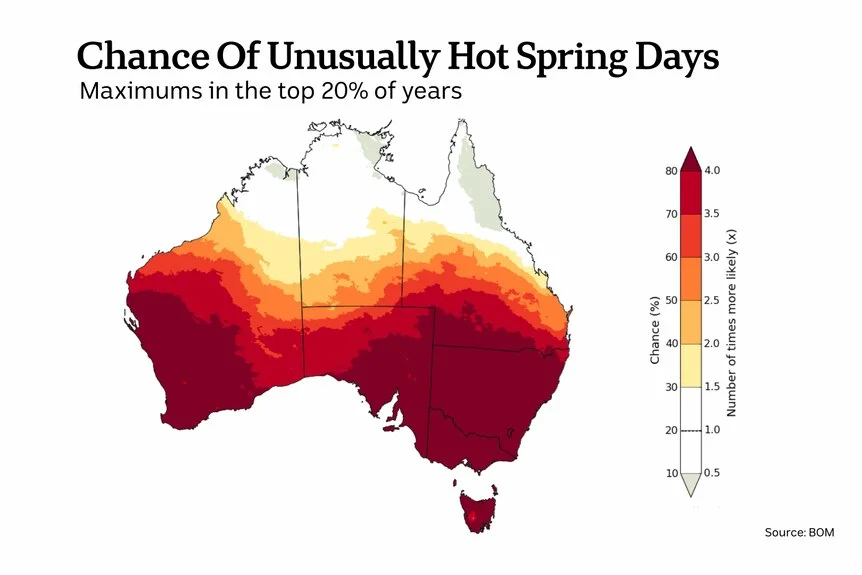
Compounding the issue, indications of a positive Indian Ocean Dipole (IOD) suggest that similar effects to El Niño may emerge from the Indian Ocean, further diminishing the chances for precipitation.
Global Context and El Niño's Broader Reach
It's essential to recognize that El Niño’s influence extends beyond just local weather anomalies. The ongoing changes in oceanic temperatures and currents continue to impact atmospheric conditions, resulting in alterations in rainfall and temperature patterns worldwide, reaching areas as far-flung as Africa and Europe.
The quantity of oceanic warmth translates into heightened global air temperatures; as noted, the climate's underlying changes propel instances of extreme heat. Record sea surface temperatures have already been recorded, and with an intensified El Niño, the trajectory for subsequent years could see unprecedented temperature averages, possibly approaching a global increase of 2 degrees Celsius over pre-industrial levels.
Concerns for Future Fire Risks
While El Niño typically causes rainfall patterns to return to average by January, the elevated temperatures tend to linger well into the new year. As a result, Australia is now staring down the barrel of what could be a summer defined by severe heat and stress on its ecosystems and communities.
The combination of higher temperatures and lower rainfall creates a scenario ripe for bushfires. Despite these concerns, a glimmer of hope persists—unlike the conditions preceding the devastating Black Summer fires, much of Australia is not currently facing a severe drought, suggesting that while there are risks, the situation may not spiral to catastrophic levels as it did in past years.
As Australia gears up for an unusual spring, the focus on El Niño highlights the necessity for preparedness. It serves as a critical reminder of how interconnected our global climates have become and underscores the importance of monitoring these patterns closely.
The upcoming months will be pivotal not just for Australia but for how we understand and respond to climate challenges on a larger scale, prompting a reconsideration of how such climatic phenomena are addressed worldwide.