Feedlots now supply nearly half of Australia’s processed beef
Feedlot production has moved from a significant part of the beef industry to close to its centre: almost half of the beef processed in Australia now comes from cattle finished on grain. More than 1.6 million cattle are in feedlots, a national record, and the sector is valued at $4.5 billion. That scale is the story. The shift is being driven by demand for beef that delivers a predictable eating experience, especially in Asian markets.
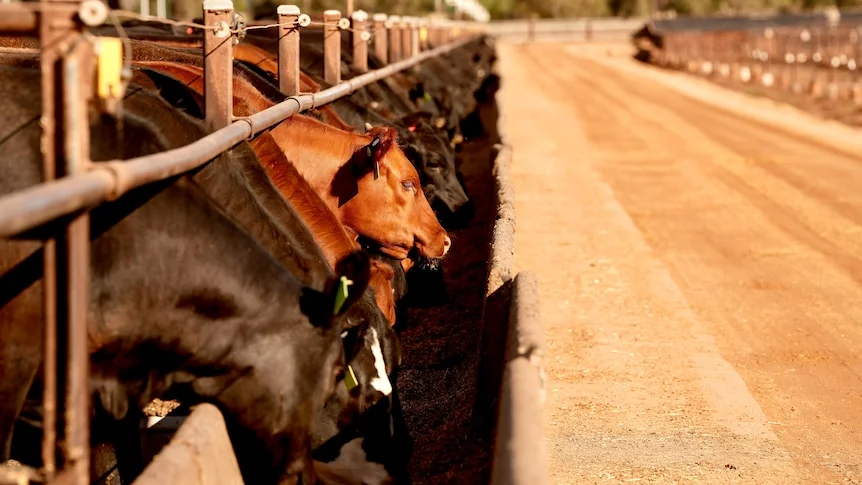
*Feedlot cattle typically gain 200 kilograms over 100 days on grain. (ABC Landline: Simon Beardsell)*
StoneX analyst Ripley Atkinson says cattle numbers on feed have risen 60 per cent in four years—an increase of 600,000 head. He describes the past five to six years as an “explosion” in growth. China, Japan and Korea are the largest markets by both volume and value, he says, and their customers prize consistency: the same kind of meal and portion from one week to the next.
That helps explain why grain finishing appeals to processors and retailers as well as consumers. But the numbers alone don’t explain how much of the expansion reflects market demand, improved production, or the industry’s confidence in current prices.
![A man in a suit standing in an office building.]()
*StoneX analyst Ripley Atkinson says feedlot numbers have climbed sharply in recent years. (ABC Landline: Floss Adams)*
Producers are adding capacity
The Herbert family has been feeding cattle in central west New South Wales for 25 years. Next year, it plans to double feedlot capacity to 12,000 head. Caitlin Herbert says conditions are positive across the chain: cattle producers, feedlots and meat processors are all benefiting from good prices.
Her father, Andrew Herbert, is the fifth generation of his family to farm at Eugowra. He manages a ration of wheat starch, cottonseed and silage, fed twice daily. Compared with 25 years ago, he says, cattle now put on 25 to 30 kilograms more. Better diets account for some of that gain; improved genetics and breeding account for much of the rest.
![A woman standing in a cattle pen.]()
*Caitlin Herbert of Gundamain Pastoral says cattle spend only a small share of their lives in feedlots and should be well cared for while there. (ABC Landline: Simon Beardsell)*
![A man in front of grains for cattle.]()
*Andrew Herbert expects to double his Eugowra feedlot’s capacity in 2027. (ABC Landline: Simon Beardsell)*
Growth may slow, but the sector expects more
Australian Lot Feeders’ Association president Grant Garey says feedlot expansion is under way across the country. He expects growth to continue, though at a slower pace than in the past five years.
Australia has an estimated 400 feedlots, most in Queensland and New South Wales. A typical facility can hold up to 10,000 cattle. Mort & Co’s
Grassdale lot near Dalby, Queensland, the country’s largest, can hold as many as 79,000.
The sector directly and indirectly employs 24,000 people, Garey says. Its production model is built around a roughly 100-day grain-finishing period: cattle consume one to 1.5 tonnes of grain and gain about 200 kilograms before slaughter. That works out to around two kilograms of weight gain for every 15 kilograms of feed each day, according to Garey. About 15 per cent of feedlot cattle stay on grain for more than 200 days.
![Grain coming out of a machine.]()
*Feedlot cattle are typically fed grain for 100 days before slaughter. (ABC Landline)*
![A man in front of grain feedlot for cattle.]()
*Grant Garey says the feedlot sector supports 24,000 jobs directly and indirectly. (ABC Landline: Simon Beardsell)*
Welfare depends on conditions—and shade remains short of target
Feedlots can meet animal welfare needs, says University of Melbourne associate professor and animal welfare expert David Beggs, but the conditions matter. Cattle need sufficient shade and suitable temperatures, well-managed feed to prevent acidosis, and dry, clean flooring. With those safeguards, he says, keeping cattle in pens for 100 days need not seriously compromise their welfare.
Accredited Australian feedlots require at least nine square metres for a 600-kilogram cow—roughly the area of a typical bedroom, Beggs says. Shade coverage is a clearer measure of unfinished work: the industry pledged that every cattle pen would have some shade by 2025, but missed that goal. Currently, 78 per cent of pens have at least some shade.
![Line up of cattle.]()
*More than 1.6 million cattle are in Australian feedlots. (ABC Landline: Simon Beardsell)*