
Last Wednesday, my eight-year-old daughter and I biked through a playground and down a long series of strip-mall parking lots, avoiding the gonzo drivers of greater Boston, past a farm and a Girl Scouts camp, to Bentley University, in Waltham, Massachusetts. We were about twenty minutes from her elementary school, on a reconnaissance mission. Traffic cones with signs temporarily forbidding parking lined the road, and a high blue fence, its netting emblazoned with the words ALLEZ LES BLEUS and the insignia of the French national team, the Gallic rooster, alongside the school’s crest lined the edge of the campus. I saw a white security tent inside the main gate and decided to keep riding. Another entrance was a few hundred yards down the road; this one was unguarded. We went in and rode past deserted buildings to a bike rack.
I had told my daughter that the French team, runners-up in the last World Cup, were practicing at Bentley, and maybe we could catch sight of them. I knew this was unlikely. “The practice area is under a no-fly zone that’s under 24-hour security monitoring with beefed-up staffing and video cams, bomb-sniffing dogs will comb the area before each practice, and anti-drone equipment sits at the ready,” the Boston Globe recently reported. But I couldn’t resist the chance to see what we could see—and to help my daughter, who had so far shown about as much interest in the World Cup as she does in doing the laundry, feel part of the action. The World Cup was here! In our back yard! Forty-eight teams, three host nations, sixteen cities—and one of them was our city, Boston. (Sort of: the last time we’d been to Gillette Stadium, in Foxborough—now called Boston Stadium, at FIFA’s insistence, for the duration of the World Cup—the drive had taken more than an hour.) One of the best teams in the world was based within biking distance. And yet, only a few days before the biggest global event on earth was set to begin, the only sign I’d seen of the impending madness was a small collection of FIFA-branded stuffed animals at our local CVS. My daughter plays soccer; a few of the kids in her class wear Messi or Mo Salah jerseys to school more days than not, and so I thought a glimpse of Kylian Mbappé, one of the greatest players alive, might stoke her interest. Or maybe she’d spot William Saliba and become inspired by his imposing physical presence. I imagined us counting down the hours to the France-Senegal game. I pictured us in the back yard with a ball, talking about Total Football and tiki-taka.
We parked our bikes, and my daughter volunteered to find someone who might be able to direct us to the soccer field. It dawned on me that my moral authority was about to crack: I was going to have to tell her that we weren’t supposed to be there. But, before I could say anything, she approached an older man shovelling dirt into one of the campus’s well-manicured garden beds and asked where we might be able to find the soccer field. “Oh, you can’t,” he said. “It’s fenced off.”
She turned to me and narrowed her eyes. “You mean we’re not supposed to be here?” she asked. The gardener looked at my daughter, and then looked at me, and then performed the sort of kindness that the FIFA president Gianni Infantino is always saying that only the World Cup can inspire: he offered us directions, involving a large hill and about twenty-seven turns, to a sand pile on the edge of campus. “Maybe, if you climb the sand pile, you can look down across the street and see something,” he suggested.
As it happened, we wouldn’t have seen anything but the freshly cut grass; the French players were arriving at Logan Airport at that very moment, before heading downtown to the Four Seasons, where the team had rented every room, for maximum privacy. But my daughter, in any case, was not going to break the rules. “You should have gotten tickets,” she said. I explained that tickets weren’t available for practices. I decided not to mention that tickets were still available for some of the games in Boston, including Saturday’s game, between Haiti and Scotland; FIFA’s dynamic pricing model listed the cheapest ones at around eight hundred dollars. And that was before you tacked on the inflated cost of getting to Foxborough. (At least only the cost was keeping us out: most Haitians are currently unable to enter the country, thanks to one of Donald Trump’s travel bans.) My daughter’s scowl deepened. “We’re going home,” she said.
“Football is enormous,” Roger Bennett, one of the founders of the football-centric podcast-and-video network Men in Blazers, told me over a video call not long ago. “The opportunity is enormous. We’re so bullish,” he said. Sixteen years ago, Bennett and Michael Davies started Men in Blazers as a single podcast. Now they have three channels: one for men’s soccer, with a particular focus on the Premier League, the Champions League, and the U.S. national team; another for women’s soccer; and a channel focussed on soccer in the Americas. There are podcasts, events, a television show; during the World Cup, Bennett will drive around the country in a giant, tricked-out orange bus. (“Like John Madden’s bus,” Bennett explained.) He envisioned “College GameDay”-style live events, with screaming fans in the background. “It’s going to be like a tidal wave for us.”
When Bennett arrived in the U.S., from England, in 1990, to work as a camp counsellor in Maine, there was so little interest in soccer that he failed to find a bar that would agree to put on the World Cup semifinal, in which England would be playing the biggest match of Bennett’s lifetime. Many of the bartenders seemed to take a kind of perverse pleasure in denying his request. (He learned from a little box in the Globe, the next morning, that his beloved team had lost on penalty kicks.) Soon afterward, Bennett moved to Chicago, where he fell in love with American culture; his first taste of an Arby’s sandwich was “life-changing,” he told me. His adoptive home had no interest in his other great love, soccer, but Bennett was undaunted. As for the worn-out soccer-versus-football debate? “In England, they use the word ‘soccer’ all the bloody time,” he said. Two of the biggest football shows in the U.K. were called “Soccer Saturday” and “Soccer A.M.” “It’s short for ‘association football,’ ” he explained. People mock Americans for using the word because the rest of the world likes a chance to make the superpower feel inferior. “Even Slovenia doesn’t fear us,” he said, referring to the U.S. men’s team. “These tiny nations and big nations know that we know that they know that we know that they know we’re crap at it.” Some British fans referred to U.S. fans as “plastic fans.” Real fans were those who attended games, home and away, in the flesh.
Bennett was in Chicago when the 1994 World Cup began. It was meant to showcase soccer’s ascendance in the U.S. The logo featured a soccer ball taking off against red-and-white stripes. But no one was paying attention at the start; on opening night, O. J. Simpson was motoring down the L.A. freeway in his white Bronco, trailed by the police. According to Bennett, a study ranked soccer as the United States’ sixty-seventh favorite sport, behind tractor pulling. Bennett went to the opening game, at Soldier Field, partly just to help fill what he imagined would be a lot of empty seats. He was shocked to find the stadium packed, mostly with Bolivians and Germans, and their descendants. When Italy later played Ireland at the Meadowlands, outside New York City, the World Cup finally burst onto the American scene. “All of New Jersey was there,” Bennett said. “It was like ‘Angela’s Ashes’ against ‘The Sopranos.’ ” That game “gave Americans permission to celebrate their identities in all of their dizzy wonder,” he said. The U.S. team performed above expectations, beating Italy and making it out of the group stage before falling to the eventual champion, Brazil. Attendance broke records. For a moment, soccer was everywhere. Andrés Cantor, who had called all Spanish-language broadcasts of the World Cup for Univision, played himself on “The Simpsons,” reënacting his iconic cry of “Gooooooaaaaalllll!” (The utterance, Cantor points out, is typical of goal celebrations in Latin America, and not unique to him, but Anglos in the U.S. seemed not to realize that.) And yet the surge lasted only a moment. “It was like one of those waves that you feel like they’re massive, but by the time they hit shore they’ve lost their power,” Bennett said. When his favorite Premier League team, Everton, was in an important game the following year, Bennett again couldn’t get it on television. To follow it, he called his parents back in the U.K., and asked them to hold the receiver up to the radio.
If the sudden popularity of soccer receded, it didn’t disappear. U.S. Soccer, which had run the tournament, finished with a surplus of fifty million dollars, and used some of that money to establish Major League Soccer, a league that has slowly but steadily taken root and cultivated loyal fan bases. The 1999 Women’s World Cup saw similar growth in interest, and arguably had a greater long-term effect: the success of the U.S. Women’s national team during the next two decades created countless new fans. Perhaps the biggest change, though, was technological: with the arrival of the internet and then of streaming TV services, the days of holding a receiver up to a radio were over. Anyone could watch Premier League and Champions League games from anywhere in the world. Soccer is “the perfect internet sport,” Bennett argued, noting that the golden age of baseball aligned with the golden age of radio, and that the rise of football (American football) is inextricable from the rise of television. Americans started following the top leagues in Europe and Latin America with fervor. These days, when Bennett flies back to the U.K., the plane is packed with American fans heading to Premier League games. And American billionaires own several of Europe’s most storied and valuable teams. (Petrocratic states control many of the others.) “Our audience is so knowledgeable,” Bennett said. “They know so much—as long as it’s mostly happened after 2014.”
As for the tepid run-up to this World Cup? Story after story highlighted the greed of FIFA and the hardening of U.S. borders at the very moment the world was set to arrive. Visas have been denied, or delayed, for a number of staffers, fans, and even players. A referee was denied entry into the U.S. simply, it seemed to him, because he was Somali. One of the host nations is at war with one of the tournament’s participants. The relationship between the U.S., which was set to host seventy-eight games, and Canada and Mexico, which were hosting thirteen each, remained uneasy. Every headline about the World Cup is worse than the last: ticket prices are outrageous, far higher than for any previous World Cup. Cities—and their taxpayers—are on the hook for the lion’s share of expenses. New York and New Jersey are fighting over who goes first on signage. Hotels are reporting unexpected vacancies. There is an unmistakable feeling that a great mass of fans are priced out, or fenced out, while wealthy sponsors and venal bureaucrats get the benefits. It was hard to say who the World Cup was for, or where it was taking place, or what it was even supposed to represent.
And yet, when the World Cup gets going, the story could change. The run-up to Qatar, four years ago, was a humanitarian disaster. By the time the tournament was over, it was considered one of the best World Cups of all time. Perhaps Americans will delight in the sight of thousands of Dutch supporters, clad in orange, marching through Kansas City, or legions of Germans following a young man playing a saxophone, or the Scottish fan who walked three thousand miles from California to Boston, to raise money for mental-health awareness in his home country and attend the Haiti-Scotland match. Only twenty-nine per cent of Americans describe themselves as “interested” or “very interested” in the World Cup, according to a YouGov poll. Fifty-nine per cent say that they don’t plan to watch any games. But the collective attention of Americans is fickle, and prone to sudden excitement. The country is also big enough that even thirty per cent of the population—around a hundred million people—is equivalent to the entirety of many other sizable nations. Spark enough interest, and you’ll have a conflagration.
“We joke on our shows that soccer is America’s sport of the future, as it has been since 1972,” Bennett said. “It’s always perpetually about to be the next big thing.” But this time, this World Cup, would be different, he insisted. “I do believe we’re in that moment where it is about to become the sport of the now, and this World Cup should cement it.”
Perhaps he was right. On Thursday, as the World Cup kicked off in Mexico City, where Mexico defeated South Africa, and then South Korea came back to beat Czechia, I started to hear reports of Scots in kilts roaming the streets of Boston. There was a man wearing a chicken costume and a Brazil jersey, and dancing to music from a boom box, at the Cortlandt Street R station in New York. “Should we all go to France-Norway on 6/26? I think the answer is hell yes,” one of my friends texted our group chat.
But I wasn’t hearing the same kinds of stories about fans of the U.S. team. The U.S.M.N.T. has a sizable following, led by a fervid group of supporters who call themselves the American Outlaws. But a lack of success in the biggest tournaments has kept it niche. Many American soccer fans root for teams from their ancestral homelands, and so even when the team plays in the U.S., its supporters are often outnumbered. The bet was that those days were over. But it wasn’t obvious to me that Liverpool fans in Brooklyn and Barcelona fans in Atlanta, people who revered Manchester City’s Erling Haaland (who plays for Norway) or Real Madrid’s Jude Bellingham (England), would transfer their allegiances to the U.S.M.N.T. during the World Cup, especially at such a divided moment in this country. “Hardcore soccer fans can recite the starting eleven,” Cantor had told me earlier in the week. But casual fans might only manage a few, he said. It didn’t help that so many of the stories surrounding the team and the tournament reflected division, exclusion, and uncertainty.
“When two teams take the field, the nation’s histories, politics, cultures, take the field along with them, that’s what makes the World Cup so like a Greek epic poem,” Bennett said. “The World Cup is massive. The fan base for football is massive. And the open question is, can an American team take advantage and write itself into that story? And I yearn for that. I ache for that.” But what would it take for that to happen?
On Thursday, I arrived in Los Angeles, where a large ad featuring Lionel Messi holding a beer greeted me as I stepped off the plane. A vending machine filled with FIFA-branded souvenirs was mostly empty. There weren’t many other signs that the U.S.M.N.T. would be playing their first game of the tournament just a short drive from the airport the next day. In the lobby of my hotel, a large archway of soccer-themed balloons framed a banner that said “WORLD CUP.” A deflated gold trophy balloon sagged to the floor.
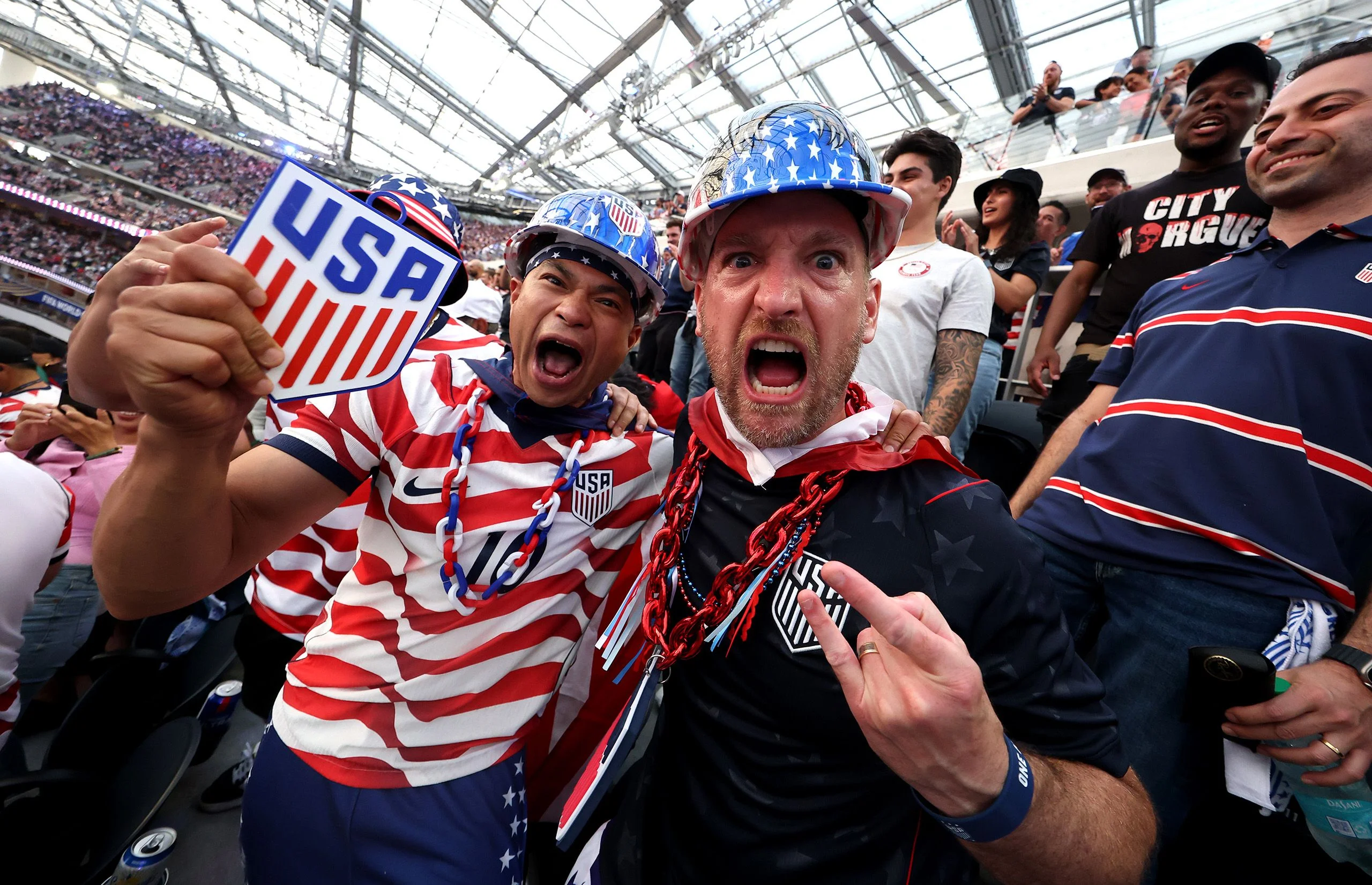
But when I got closer to the stadium, a couple hours before the U.S. was set to kickoff against Paraguay, I was surrounded by throngs of people wearing brand-new red-and-white striped jerseys or U.S. soccer T-shirts. They had red, white, and blue facepaint streaked onto sunburned cheeks and American flags draped over their shoulders. It was hard to spot a ticket-holder who wasn’t decked out for the occasion. Despite all the stories about lagging ticket sales, nearly all of the seats inside the stadium were filled by the time the players were introduced, and chants of “U.S.A.” grew loud.
It had been hard to get a grasp on the team’s chances. Even the makeup of the team was unclear until only a few weeks earlier. But seven minutes into the match, Christian Pulisic, a winger for A.C. Milan and for years the U.S. team’s most important player, received a pass from Weston McKennie, accelerated into the box, split two defenders, and sent it back to McKennie. McKennie tried to play it across the goal, hoping to find another American streaking up the right side, but a Paraguayan defender stuck out his foot and deflected the ball past his own goalkeeper. The crowd erupted.
The early score seemed to settle the team, which had looked disjointed for the first few minutes. From that point on, the U.S. dominated, pressuring and often overwhelming the Paraguayan defense with speed and precise passing. After thirty minutes, Pulisic crossed the ball to Folarin Balogun, who scored. Balogun grew up in England and came through the English youth system, but was eligible to represent the U.S. by virtue of having been born while his mother was on vacation in New York. He was regarded as a promising prospect in England, and when he decided to play for the U.S., after heavy recruitment, it was a coup. He is just the sort of goalscorer that the U.S. has often lacked. “At a certain point you need a guy to put the team on his back,” Leander Schaerlaeckens, author of “The Long Game: U.S. Men’s Soccer and Its Savage, Four-Decade Journey to the Top, or Thereabouts,” told me a few hours before the game. For all of Pulisic’s dazzling skills, he was at his best when he didn’t have to be that guy. “When push comes to shove, the basic chemistry of winning games is, who’s the guy who’s going to take charge?” In Balogun, it seemed Pochettino had found his answer.
Twenty minutes later, Balogun scored again, after shaking off a tackle and sending the ball just inside the goalpost. By halftime, the U.S. had controlled the ball for more than seventy per cent of the game and was up 3–0. It was by far the best the team had played since the current coach, Mauricio Pochettino, arrived two years ago, after coaching several high-profile club teams in Europe—and perhaps the best half the team had ever played at a World Cup. It was, at least, hard to imagine them playing any better. The Paraguay players looked stunned. They came into the tournament known for their defense, but, under the attacking pressure of the U.S., had to resort to fouling to slow the Americans down.
As the U.S. squad transitioned into a more conservative game-managing approach, the quality fell off slightly, and Paraguay capitalized on a defensive breakdown to score a goal of their own. Then, in the final seconds of stoppage time, Gio Reyna, who’d come on as a substitute, curled a gorgeous shot off the outside of his boot into the goal. It was a redemption for Reyna, who’d been benched during the previous World Cup and criticized by the team’s coach, Gregg Berhalter, for showing a lack of effort in practice—which led to a sordid drama within the team. Berhalter survived the scandal, but he was eventually fired, following an embarrassing showing at another tournament. Now Reyna was being mobbed by his teammates—including Berhalter’s son, also a member of the squad. The team’s four goals were more than the U.S. scored during the entire 2022 World Cup.
“We need to play with passion and make the fans feel proud about what they are seeing on the field, I think, to create that emotional relationship, and then you will do the rest to try to encourage the people to celebrate,” Pochettino said earlier this week. “We need the support of our fans.” That support should deepen as the public becomes more aware of individual players, as they learn the names not only of Pulisic but of McKennie and Balogun and the rest. Still, as Pochettino pointed out, the quickest way to create those emotional relationships, the sense of being part of something, is to win. “A real dream,” Balogun said to reporters after the match, when asked about his experience. “It’s a dreamy night.” ♦
An earlier version of this article misidentified the participants of the Men in Blazers bus tour.