Australia’s Dietary Guidelines Delayed as Review Weighs Global Food Debate
Australia’s dietary guidelines are running late as the review committee weighs contested evidence on nutrition, sustainability and ultra-processed foods. The delay puts policy work that depends on the guidelines on hold, while drawing fresh attention to how international food debates shape national advice.
The updated guidelines were first expected in 2025, then shifted to 2026. They’re now due for completion sometime in 2027. The National Health and Medical Research Council (NHMRC) says draft recommendations are expected to go out for public consultation in December 2026, subject to approval by its council.
That timetable matters beyond the guidance itself. The national review informs Australia’s Guide to Healthy Eating, as well as food marketing and labelling standards and school canteen guidance. Those policies can’t be developed or refreshed until the review is delivered.
A wide brief, under close scrutiny
The NHMRC, an independent agency, is overseeing a review that covers general nutrition science alongside the environmental effects of food choices and the health impacts of ultra-processed foods. The council says the evidence base is large and has required systematic screening and consideration.
“This process is necessary to ensure the robustness and transparency of the evidence review process,” an NHMRC spokesperson said.
The scope has attracted pushback. Cattle Australia objected to including environmental considerations, saying it would “create a dangerous channel for misguided ideology”. Sustainability already features in dietary guidance in countries including Brazil, Qatar, Sweden and Germany.
Nutrition experts interviewed about the delay say the extended review reflects care in assessing the evidence. The bigger pressure, in their view, is that food advice has become a contested public debate, amplified by political decisions and online personalities.
US advice carries influence beyond its borders
Australia’s review is unfolding amid a sharp dispute over the United States’ dietary guidance, updated in January. The new recommendations put more emphasis on animal products such as red meat and advise moving away from processed foods. Public health lawyer Alexandra Jones, who leads food governance at the George Institute for Global Health, says US recommendations have long carried international weight because many global food companies are headquartered there.
Food policy has also faced criticism over industry influence in the United States. Jones says industries have historically “infiltrated” dietary committees. Nutrition specialists have broadly challenged the latest US advice; in August, the Physicians Committee for Responsible Medicine filed a federal lawsuit seeking its withdrawal. The lawsuit alleges that a hastily assembled, secret panel of “meat, dairy, and fad diet industry insiders” was chosen to advance those sectors’ interests.

International guides offer a different model
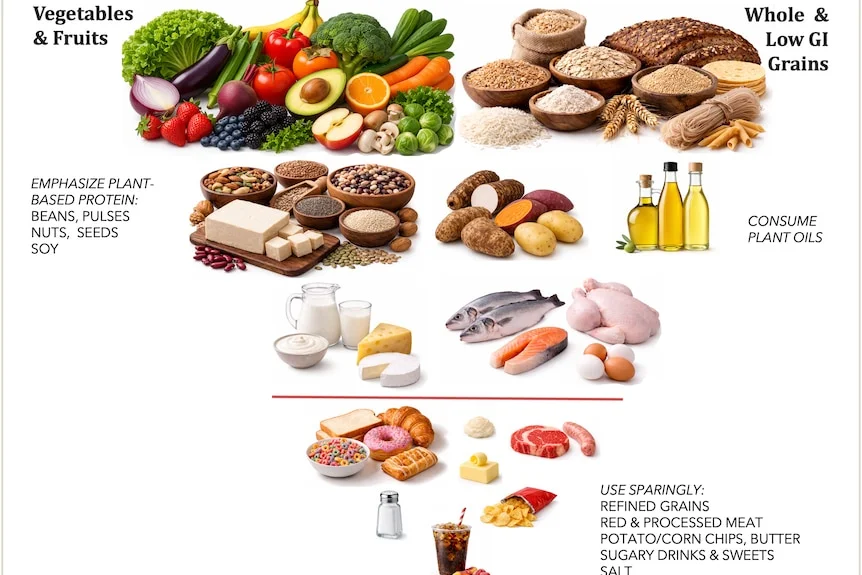
A multinational group of nutrition scientists has developed a global food pyramid partly in response to the reach of US guidance. Its recommendations favour plant proteins, put fish and poultry ahead of red meat, and call for moderate dairy consumption, with environmental effects in view.
Co-author Jennie Brand-Miller, a professor at the University of Sydney, says the guide identifies nutritional strengths shared across different food cultures. It also reflects a sustainability approach already present in at least 35 national nutrition guidelines.
Brand-Miller argues that evidence-based national guidance remains especially valuable as nutrition influencers compete for attention. Some, she said, have financial interests or personal biases that conflict with dietary recommendations.
Why an Australian review still matters
International examples can inform the process, but Australian guidelines need to serve local needs, Brand-Miller said. She described the delay as evidence of rigorous debate within the review committee and questioned whether the latest US recommendations deserved the trust Australian policymakers once placed in them.
“In the past, the American dietary guidelines have been a starting point for the Australian dietary guidelines with the assumption that a lot of sensible, well-trained people have put in an enormous effort into the American dietary guidelines,” she said. “But for the first time, I don't think that's true.”
The next concrete milestone is the planned December consultation draft. Its handling of environmental effects and ultra-processed foods will show how the committee is translating a broad and contested evidence base into advice for Australian households and the policies built around it.