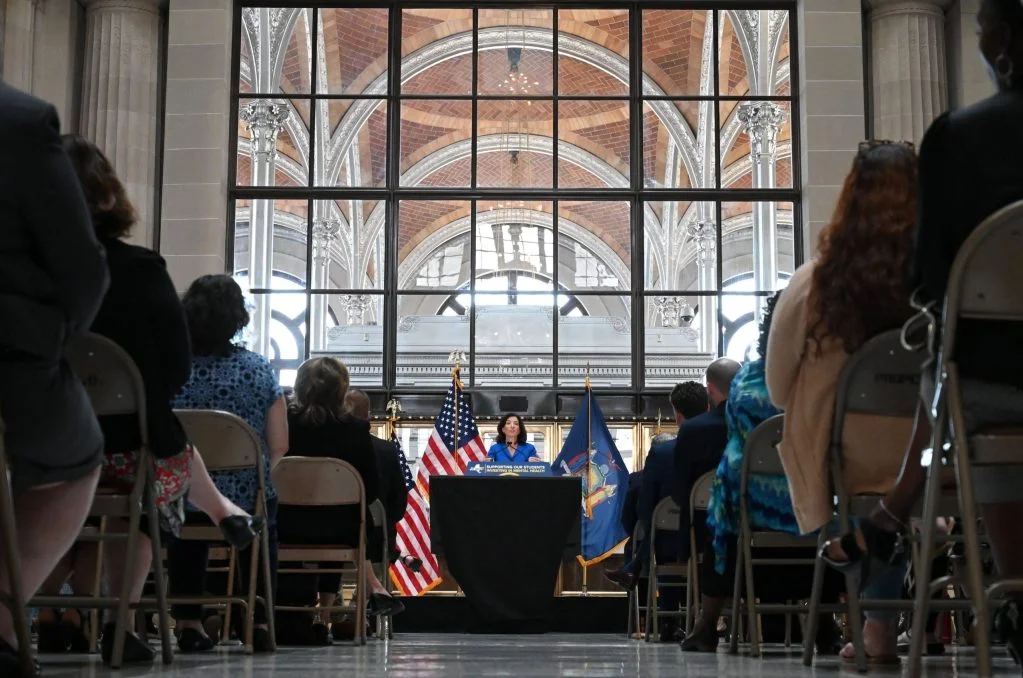
Standing before first graders in Albany last April, New York Gov. Kathy Hochul announced an ambitious goal: The state would overhaul its literacy instruction and push third-grade reading proficiency from 45 percent to at least 60 percent. "We're turning the page on how we teach students how to read," she declared.
Her newly signed "Back to Basics" budget legislation mandated that every district adopt the "science of reading"—an evidence-based approach emphasizing explicit phonics instruction that teaches children the relationship between letters and sounds.
The law allocated $10 million to retrain 20,000 teachers in this research-backed method, entrusting the funds to New York State United Teachers, the state's primary teachers union, to develop the training course. The union rolled it out last September.
But literacy experts who've reviewed the course say it contradicts current research and promotes teaching strategies proven ineffective—methods that could actually hinder student progress. The training contains too much material from the outdated reading approach Hochul vowed to eliminate, these reviewers warn.
The concerns come as New York's reading scores decline while states that have invested heavily in evidence-based literacy instruction see gains.
"There are just lots of inaccuracies and very old citations," said Susan Neuman, a New York University professor specializing in early literacy development, after examining 18 sample slides from the course. "We've spent $10 million on this? Can I get a refund?"
The problematic strategy, called "balanced literacy," conflicts with the science of reading. It treats phonics as merely one option for word identification, teaching students to also rely on context clues, sentence grammar, visual appearance and pictures—an approach called "three-cueing," which some researchers compare to guessing.
A review published last year analyzed 68 studies comparing balanced literacy with "structured literacy," a science of reading-based approach. The findings provide "strong evidence that [structured literacy] programs are more effective than [balanced literacy] programs in improving a range of literacy skills," researchers concluded.
Hochul's plan explicitly promised to eliminate balanced literacy. "With this budget, we're throwing out debunked reading instruction practices and getting back to basics, using phonics, reading comprehension and other effective techniques to set our kids up for success," she said in a press release.
Related: A lot goes on in classrooms from kindergarten to high school. Keep up with our free weekly newsletter on K-12 education.
The union's course was meant to arm teachers with evidence-based methods. Instead, literacy advocates who completed it—and national and state experts who reviewed portions—say the training may set the state back by promoting balanced literacy and sometimes misrepresenting what research shows about how children learn to read.
The criticism arrives as more than one in five state school districts still use balanced literacy or other non-evidence-based curricula, according to new data. New York lags behind most states in adopting evidence-based instruction, according to organizations tracking state literacy policies.
More New York children are struggling to read. In 2009, 29 percent of fourth graders scored at the lowest level on the National Assessment of Educational Progress—the Nation's Report Card—meaning they lacked even partial mastery of grade-level reading skills. That figure climbed to 34 percent by 2019 and 41 percent by 2024. Research shows these results are troubling: Children who struggle with reading by third grade rarely achieve proficiency and are four times less likely to finish high school.
New York's trajectory contrasts sharply with states like Mississippi and Louisiana, which have implemented comprehensive science of reading measures, according to a 2025 analysis by ExcelinEd, an early literacy advocacy group. Those measures include ongoing teacher training in the science of reading, district adoption of research-based instructional materials and more. The analysis found New York had implemented just two of 18 policies it considers essential to a comprehensive early literacy strategy—tied for last place with Maine and Illinois.
The teachers union training, launched September 18, was supposed to address that gap. Lori Govenettio, a professional development specialist for the Syracuse-based Reading League, which promotes evidence-based reading instruction, was among the first to enroll. She wanted to evaluate whether it could serve as a resource for teachers she supports.
When she logged into the first October session, she was surprised the instructor seemed unfamiliar with the science of reading. The instructor read from a script and hadn't heard of a well-known controversy in literacy circles about teaching children sounds without showing corresponding letters. Later, the trainer displayed a slide on using a balanced literacy tool called a "running record" to assess reading ability—despite the state rejecting that tool under Hochul's Back to Basics plan as inconsistent with the science of reading.
Small details were also incorrect. The instructor shared a video from a Taiwan-based company meant to demonstrate students learning letter-sound correspondences. In it, some sounds are mispronounced—for instance, "m" is pronounced "muh" instead of "mmm."
Related: Reading comprehension loses out in the classroom
Across the state, literacy advocates heard similar reports. Deborah Aiello, founding member of the Long Island Literacy Coalition, which promotes evidence-based reading instruction, said teachers told her the union's instructors appeared new to the science of reading and promoted balanced literacy tools during the course.
National literacy experts who reviewed course excerpts shared with The Hechinger Report also criticized the content.
One slide, citing literacy researcher Isabel Beck and colleagues, categorizes word types. It defines "precision words" as those used more in writing than speech—"cite" and "evaluate," for example—noting these don't "usually require explicit instruction." Beck said the slide inverts her work: What it calls precision words do require explicit instruction. That's one of three substantive errors on that slide alone, she said. "I don't want my name on this."
Tim Shanahan, professor emeritus at the University of Illinois at Chicago and former chair of two federal literacy panels, found problems with five slides. One states that high-frequency words "can easily be decoded"—a claim that isn't accurate, he said. Many high-frequency words come from Anglo-Saxon spelling traditions and are irregular. "I think that would be a slide I'd say, 'Get rid of that or rewrite it dramatically.'"
Another slide presents a "debate" between the "phonics approach" and the "whole language approach," whose concepts were incorporated into balanced literacy. Both "aim to enhance students' reading skills and comprehension through different methods," the slide states. But scientific literature "really contradicts" the whole language approach, said Mark Seidenberg, professor emeritus and cognitive neuroscientist at the University of Wisconsin-Madison. "It has been abandoned in many parts of the country."
The New York State Department of Education declined to answer questions about these criticisms, who reviewed the course, instructor qualifications or course content suggesting balanced literacy aligns with the science of reading. The department referred all questions to New York State United Teachers and the governor.
"NYSUT advocates for structured literacy and science of reading-aligned instruction and practices. We do not advocate for balanced literacy in our course," said Jaime Ciffone, the union's executive vice president. The course allows educators to have "deep discussions around the shift from balanced literacy and why that's no longer evidence-based," she said.
A slide referencing running records, a balanced literacy tool, has been removed because it caused confusion, Ciffone said. "The beauty of this course is that we're able to have the flexibility to take in the feedback and reflection and make any adjustments."
The Hechinger Report pressed Gov. Hochul on whether she had explored adopting proven science-of-reading programs already in use — such as an introductory course for New York City teachers showcased to National Governors Association officials in 2025 — instead of funding a new training from scratch.
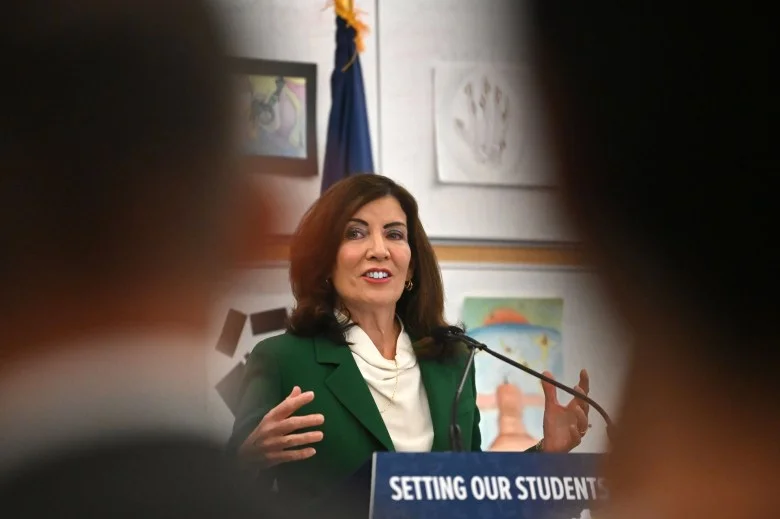
Emma Wallner, a spokesperson for Hochul, said in an email that the state education department and the teachers union are continuing to refine the training. The governor's office "remains engaged in supporting the rollout of the Science of Reading" to ensure successful statewide implementation, she wrote.
Literacy advocates say the course content reveals how deeply balanced literacy remains entrenched across New York.
Hochul's 2024 plan mandates that districts annually certify their use of science-of-reading-aligned curricula and teaching methods. But state law reserves curricular and instructional control for local districts. That means individual districts — not the state — make the final call on whether their methods align, according to state guidance documents.
Many districts claiming alignment are actually mixing balanced literacy with science-of-reading principles, said Jeff Smink of EdTrust-New York, a nonprofit that launched a 2024 campaign targeting the state's "literacy crisis." As of December, 147 districts — roughly 21 percent — were still using curricula rooted in balanced literacy or other non-evidence-based approaches, according to records EdTrust obtained through a freedom of information request.
Related: Many students can't read, even in high school. Is the solution teaching reading in every class?
Research on blending these approaches is scarce, but experts are skeptical. Shanahan said balanced literacy programs typically have fundamental flaws that can't be fixed by adding phonics instruction, making it "hard to imagine that it would be a sufficient response." Neuman, the early literacy professor, was blunter: "When you take two systems that are so diametrically opposed, what you're doing is adding to children's cognitive load in a very dramatic manner."
One family says balanced literacy has blocked their children from learning to read. Anne — who asked to use only her middle name for fear of retaliation — lives in the Indian River Central School District outside Philadelphia, New York, with her husband and their second- and third-grade children.
Despite nightly reading at home, both children have struggled since kindergarten. When Anne and her husband reviewed their second grader's oral reading quizzes, they noticed the child was guessing at words rather than decoding them — reading "the" as "a," "a" as "my," and "the" as "my." Tests the child passed included pictures that provided word clues. When Anne printed the same text and covered the images, her child couldn't read it.
Alarmed, the couple hired private tutors last May who use structured literacy grounded in science-of-reading principles. Since then, both children have progressed more than in the previous three years combined, Anne said. In late January, she watched her older child independently read a new book for the first time. "He was so excited," she said. "It was like a lightbulb moment."
But tutoring costs $330 weekly. The family is depleting their savings and unsure how long they can afford to continue, Anne said.
Tanya Roy, a literacy coach in the Indian River district, said all kindergarten through third-grade students have received at least 20 to 30 minutes of daily phonics instruction since 2016.
However, the district also employs the cueing system, including having students identify words using accompanying pictures, she said. Irregular words like "the" must be memorized because they can't be sounded out, Roy explained. That contradicts two core science-of-reading principles: that even irregular words can be decoded by memorizing only the irregular portion, and that whole-word memorization undermines students' grasp of letter-sound relationships.
State data underscore the district's reading challenges: 56 percent of fourth graders score below proficient in English, compared with 46 percent statewide.
Frustrated by districts' reluctance to abandon balanced literacy, two Democratic state legislators introduced bills last year requiring the education department to create a list of evidence-based reading curricula — as several other states have done — and provide grants for districts to purchase them. All teachers would complete 35 to 50 hours of training on approved curricula, and both bills would prohibit cueing.
The measures remain stalled in committee. An unnamed state education department spokesperson told the New York Post last October that "a one-size-fits-all mandate is not the answer."
Assembly sponsor Robert Carroll said parents and administrators deserve input on school operations. "But that doesn't mean we shouldn't make sure that schools and teachers are providing the best practices and best instruction," he told The Hechinger Report.
At the federal level, legislation advancing through Congress would redefine permissible literacy instruction, effectively prohibiting approaches like three-cueing in programs receiving federal reading funds.
Until roughly three years ago, New York was doing "absolutely nothing" on science of reading, said EdTrust's Smink. The state has since made progress, "but a lot more work needs to be done to catch up with the rest of the country."
Update: This story has been updated with comments from a NYSUT official, who responded after publication.
Contact editor Meredith Kolodner at 212-870-1063 or [email protected]or on Signal at merkolodner.04.
This story about phonics and the science of reading was produced by The Hechinger Report, a nonprofit, independent news organization focused on inequality and innovation in education. Sign up for our weekly newsletter on K-12 education.
The post Did New York blow $10 million on reading instruction that doesn't work? appeared first on The Hechinger Report.